Executive summary: Transferable tax credits (TTCs) are federal clean energy and manufacturing tax credits that one taxpayer can sell to another for cash under §6418 of the Internal Revenue Code, enacted in the 2022 Inflation Reduction Act. Buyers purchase the tax credit at a discount to face value (typically $0.90–0.95 per $1.00 of credit), apply it against federal tax liability, and rely on seller indemnities and tax insurance to manage risk. Deals facilitated by Crux close in about three months, on average.
Transferable tax credits (TTCs) are federal tax credits that can be sold to another taxpayer for cash under the Inflation Reduction Act's transferability provisions. The mechanism enables clean energy developers and U.S. manufacturers to monetize tax credits more efficiently while allowing buyers to reduce federal tax liability at a discount to face value. Since its enactment in 2022, transferability has helped catalyze more than $750 billion in private capital across US energy and manufacturing projects.
In this guide, we’ll review the essential information that transferable tax credit buyers, sellers, and intermediaries need to know to leverage this opportunity fully, including:
Sign up for The Crux of It newsletter to keep up with the latest market insights
Transferable tax credits (TTCs) are federal clean energy and manufacturing tax credits that an eligible taxpayer can sell to an unrelated taxpayer for cash under §6418 of the Internal Revenue Code (IRC). The buyer applies the purchased credit against their federal income tax liability; the seller receives cash without forming a partnership with the buyer. Section 6418 was enacted in the 2022 Inflation Reduction Act (IRA) and sits alongside traditional tax equity as a complementary path to monetize clean energy and manufacturing credits.
The ability to freely sell tax credits in a robust private market has several distinct advantages:
TTCs have rapidly become one of the largest sources of clean energy financing in the United States. Since transferability was introduced through the Inflation Reduction Act in 2022, the market has expanded to include thousands of buyers, developers, manufacturers, and intermediaries.
TTCs have catalyzed more than $750 billion in private investment across clean energy, manufacturing, and domestic supply chain projects since 2022.
The 11 federal tax incentives for clean energy are:
Historically, zero-emissions energy project developers were required to enter joint ventures and leasing arrangements with other private companies with sufficient tax liability to capture the full value of the major clean energy tax credits, such as the investment tax credit (ITC) and production tax credit (PTC). These arrangements are known as "tax equity" and are relatively complex financing structures. In a tax equity relationship, tax investors invest directly into partnerships with developers and receive a special allocation of cash, tax credits, and depreciation in exchange.
Traditional tax equity deals are structurally complex and generally require domain knowledge as well as monitoring and oversight capabilities. Consequently, they are often limited to large projects with experienced sponsors and significant credit volumes. Smaller or newer developers often can’t meet these thresholds.
The transfer market offers a simpler, more scalable alternative to traditional tax equity that allows a wider range of developers, manufacturers, and energy technologies to monetize tax credits and unlock capital. Transferability remains a private-market mechanism, relying on buyers and sellers to conduct appropriate due diligence and maintain meaningful economic exposure to each transaction.
Transferability also creates opportunities for a wider range of technologies. While tax equity has historically been limited to established clean energy technologies such as wind and solar, TTCs have a broader scope, including nuclear, hydrogen, geothermal, biogas, and advanced manufacturing.
This flexibility not only drives economic growth in terms of domestic manufacturing, but also incentivizes innovation in the development and commercialization of next-generation clean energy technology.
That investment comes at an opportune time — energy demand is rising for the first time in decades, driven by artificial intelligence (AI), cloud computing, and domestic manufacturing. Transferability provides powerful incentives to invest in and build the energy infrastructure that will be required to deliver reliable, affordable electricity.
The tax credit transferability feature for various clean energy tax credits included in federal legislation allows a larger universe of corporate taxpayers to take advantage of the credits because they do not require complicated tax equity structures. Tax credit transferability is a simpler structure and should entice a much bigger pool of corporate taxpayers to participate in clean energy project financing.
With more buyers, a larger pool of developers and manufacturers should benefit from the ability to monetize their tax credits and the simpler process for doing so. Tax credit monetization plays a significant role in capitalizing clean energy projects, so more capital access should be a catalyst for many developers and manufacturers, especially those that may not have established relationships with tax equity providers.
Read more: Benchmarking corporate participation in the tax credit market
At Crux, we're creating the capital platform that will enable sellers and buyers to transact tax credits with clarity and confidence:
Our expert team, market-validated standards, and purpose-built tools streamline transaction execution for all parties, facilitating more investment in clean energy and critical infrastructure.
To complete a transferable tax credit transaction, sellers and buyers complete a transfer election statement that includes the IRS registration number for the eligible credit. The transfer election statement must be attached to both the buyer’s and seller’s tax returns.
Pre-filing registration with the IRS is required before a transferable tax credit can be claimed, but registration does not need to occur before a transaction is signed or funded. In practice, deals are routinely executed and cash changes hands before the seller has completed the IRS pre-filing registration. Treasury guidance supports this sequencing, clarifying that a buyer may account for a credit it “has purchased, or intends to purchase, when calculating its estimated tax payments” — meaning the transaction and the registration process run on parallel tracks, not sequential ones.
Advisors play an important role in providing diligence, insurance, and indemnification for buyers of TTCs:
A credit buyer’s critical review will focus on:
Stakeholders will look at appraisals, cost-segregation reports, and legal/tax opinions.
Buyers will also want to ensure that the typical series of project documents is in place (e.g., engineering, procurement, and construction agreement, interconnection agreement) and evaluate the credit support and creditworthiness of the developer.
Crux’s purpose-built tools streamline the diligence process. The Crux data room will automatically populate market-validated diligence checklists, making it easy for buyer counsel to identify documents and request additional materials directly in the platform.
Indemnities are a key protection for buyers in TTC transactions, offering contractual remedies if the credits are later disallowed or recaptured. Rather than participating in project cash flows, buyers rely on these protections to mitigate risks tied to credit ineligibility or project noncompliance.
Coverage amounts are typically negotiated, with many buyers seeking indemnities equal to at least 100% of the credit value to cover potential penalties or interest. Deal terms may include “make-whole” provisions (ensuring full reimbursement), as well as caps, survival periods, and liability limitations.
Insurance is a key type of indemnity that helps protect buyers by offering additional security in case a seller cannot fulfill their obligations. In transferable tax credit transactions, tax insurance policies are commonly used to cover risks such as credit disallowance or recapture, especially when a developer has limited creditworthiness or when buyers want added assurance beyond other negotiated indemnities.
Crux has observed insurance coverage levels below 100% in situations where insurance is a credit-enhancement tool for a seller. However, insurance coverage ranging from 90–140% is substantially the most common coverage percentage. A small portion of deals include coverage in excess of 140%, up to 165%. The seller typically covers the cost of insurance coverage, which ranges from 2–5% of the insured limit of the credit, depending on coverage and sizing.

Get our latest insights and favorite reads on the transferable tax credit market in your inbox.
Any eligible taxpayer (under the IRS definition) can take advantage of tax credit transferability, meaning that tax-exempt organizations are generally ineligible. Corporations and even individuals can buy tax credits.
While the buyer can be an individual, they will be subject to active and passive activity restrictions — the face value of transferable tax credits can only be used to offset tax liabilities from passive, non-investment income.
Some high-net-worth individuals and family offices that have previously participated in the tax equity market may find TTC deals appealing if they can time the payout closer to their tax-filing date. However, we do not expect the tax credit market to open widely to individuals.
On average, tax credit transfer deals facilitated by Crux close in about three months, though timing varies depending on diligence complexity and internal approvals.
Below is a sample timeline:
Total timeline: 3-–8 months (indicative internal time investment: 20–40 hours)
The two phases run partly in parallel — internal approvals frequently begin before credit search — so total elapsed time is less than the sum of the phase ranges.
Preparation phase (1–5 months):
Transaction phase (5–11 weeks):
Credits are typically sold at a discount to their face value, indicated as cents on the dollar (e.g., a $0.93 TTC price indicates a 7% discount to the face value of the tax credit).
Investment-grade versus non-investment-grade ITC and PTC pricing, 2025
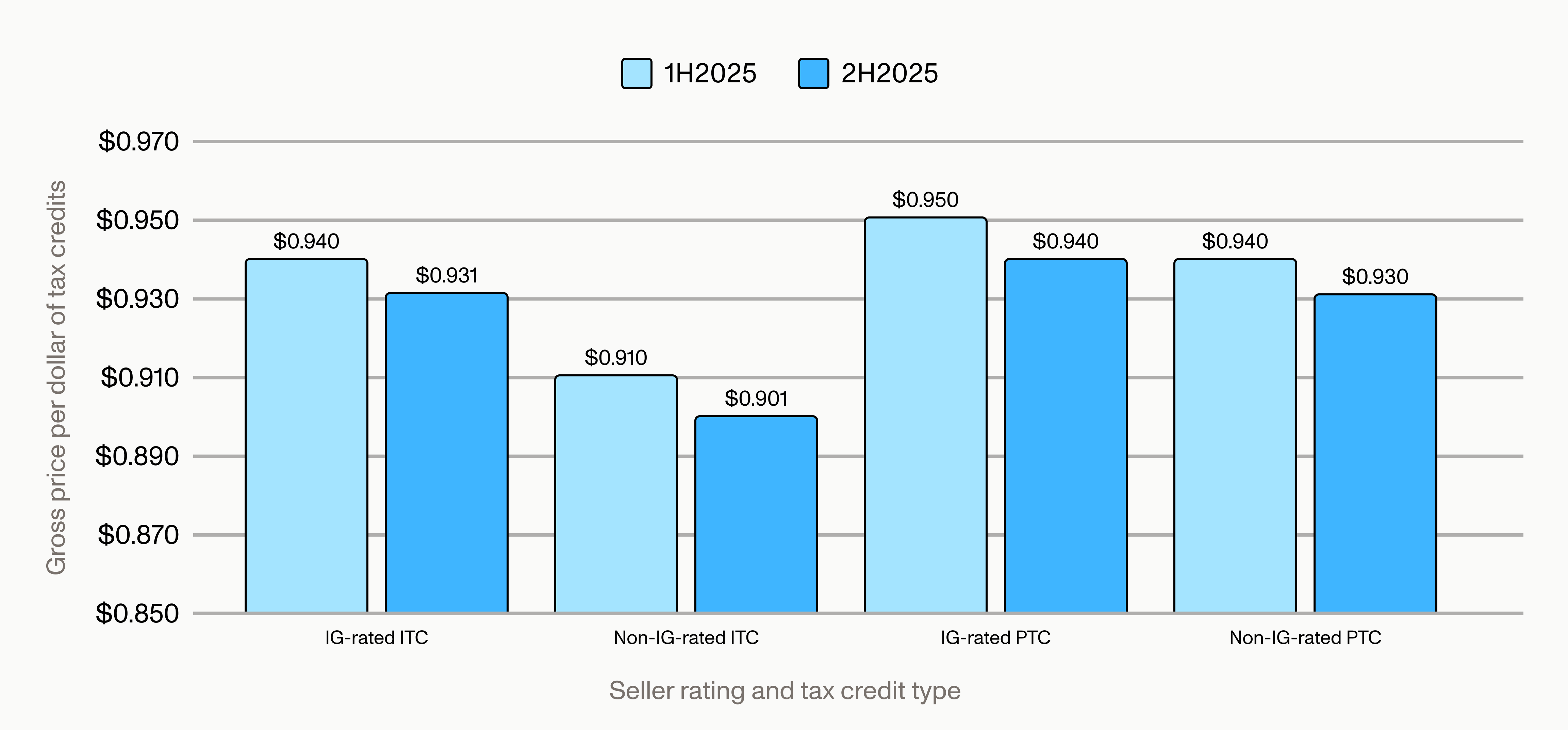
Internal rates of return on tax credit transactions are particularly high, and corporations are doing their best to time credit purchases with their quarterly estimated payments. Most taxpayers set aside cash to make tax payments, including quarterly estimated payments.
Those funds would not normally generate a return; companies cannot choose between paying taxes and building factories. With tax credit transferability, reserved cash suddenly has the capacity to generate a real cash return, making TTCs a uniquely attractive investment.
Transaction costs can include fees for advisors, legal counsel, syndicators, and due diligence efforts such as appraisals or cost-segregation reports. These costs vary depending on deal complexity and size. The seller typically covers these fees up to a negotiated cap, though exact terms may vary by transaction.
The primary risks in transferable tax credit transactions include recapture risk, eligible basis risk, documentation deficiencies, and developer creditworthiness.
Most buyers mitigate these risks through diligence, indemnities, and tax insurance.
Read more in our guide to tax credit transaction risks for corporate taxpayer
Still, there are some key risks that buyers and sellers will have to navigate, particularly in the case of ITCs:
Recapture is the IRS's right to reclaim a previously claimed investment tax credit if the underlying project ceases to be eligible during the five-year recapture period that begins on the project’s placed-in-service date. Recapture applies only to ITC-generating projects under §§48 and 48E; production tax credits are not subject to recapture once earned.
In a transferable credit transaction, the buyer holds the recapture liability. Buyers are typically protected through two mechanisms:
Because buyers don't participate in project cash flows, ongoing project viability matters to them only insofar as it avoids recapture during the five-year window and preserves the seller's ability to honor the indemnity.
As with tax equity, the developer will be responsible for maintaining and operating the system throughout the recapture period and supporting whatever indemnities it gives to the buyer. A developer declaring bankruptcy and abandoning a project could trigger recapture. A benefit of transferability is that, after the recapture period, the transaction with the tax credit buyer is fully resolved.
One of the more important risks is ensuring that the stated basis level is eligible for tax credits. Some credit sellers are accustomed to “stepping up” project value through a sale to a tax equity partnership before monetizing the credit, allowing the ITC to be calculated based on fair market value rather than project cost. In a direct transfer, credits are generally valued based on cost, making accurate cost-basis documentation critical. Developers typically provide the engineering, procurement, and construction (EPC) agreement, appraisal, and cost-segregation report as part of diligence.
Similar to recapture risk, basis risk is commonly covered by tax credit insurance, for which the seller typically bears the cost. Buyers may also purchase uninsured credits at a steeper discount.
Federal tax policy entitles the tax credit buyer to carry the TTC forward for 22 years and back for 3 years, meaning that the buyer has up to 22 years of future tax filings to utilize the full value of the credit. They can also carry the tax credit back and apply it to previous years, as far as three years in the past.
However, the carryback is not as simple as applying the credit to the previous year’s return:
Companies will have filed tax returns during these periods, so applying tax credits to previous years requires refiling taxes for as many as three previous tax years, and thus may be a prohibitively complex process.
Carryback process for transferable tax credits

In the rapidly developing TTC market, one of the biggest challenges is the timing gap (like in the tax equity market). Developers and manufacturers want to move forward with as much certainty and commitment as possible, while buyers want to outlay cash as close to quarterly estimated payments as possible.
With that in mind, final guidance from the IRS has confirmed that transferable tax credits can be applied to tax liabilities in the same year they are generated. This means buyers should complete the purchase before the end of the tax year so they can claim the credits.
It’s also important to remember that the seller and buyer must complete the IRS pre-filing process, which can take several weeks. Timing deals and negotiations correctly is critical.
Learn how Crux’s expert team supports you through the entire transaction
In general, buyers seek to align purchases of TTCs with their quarterly estimated tax payments. This can create a seasonal rhythm to deal activity, though the exact timing of transactions varies based on market dynamics and available supply.
Transferable tax credit buyers generally prioritize:
According to the IRS, eligible entities that wish to pursue a transferable tax credit transaction may take the following steps (noting that not all steps need to occur in the order listed below):
Certain clean energy projects may qualify for bonus tax credit (also known as “adders”) that increase total credit value.
Tax credits with applicable bonus adders
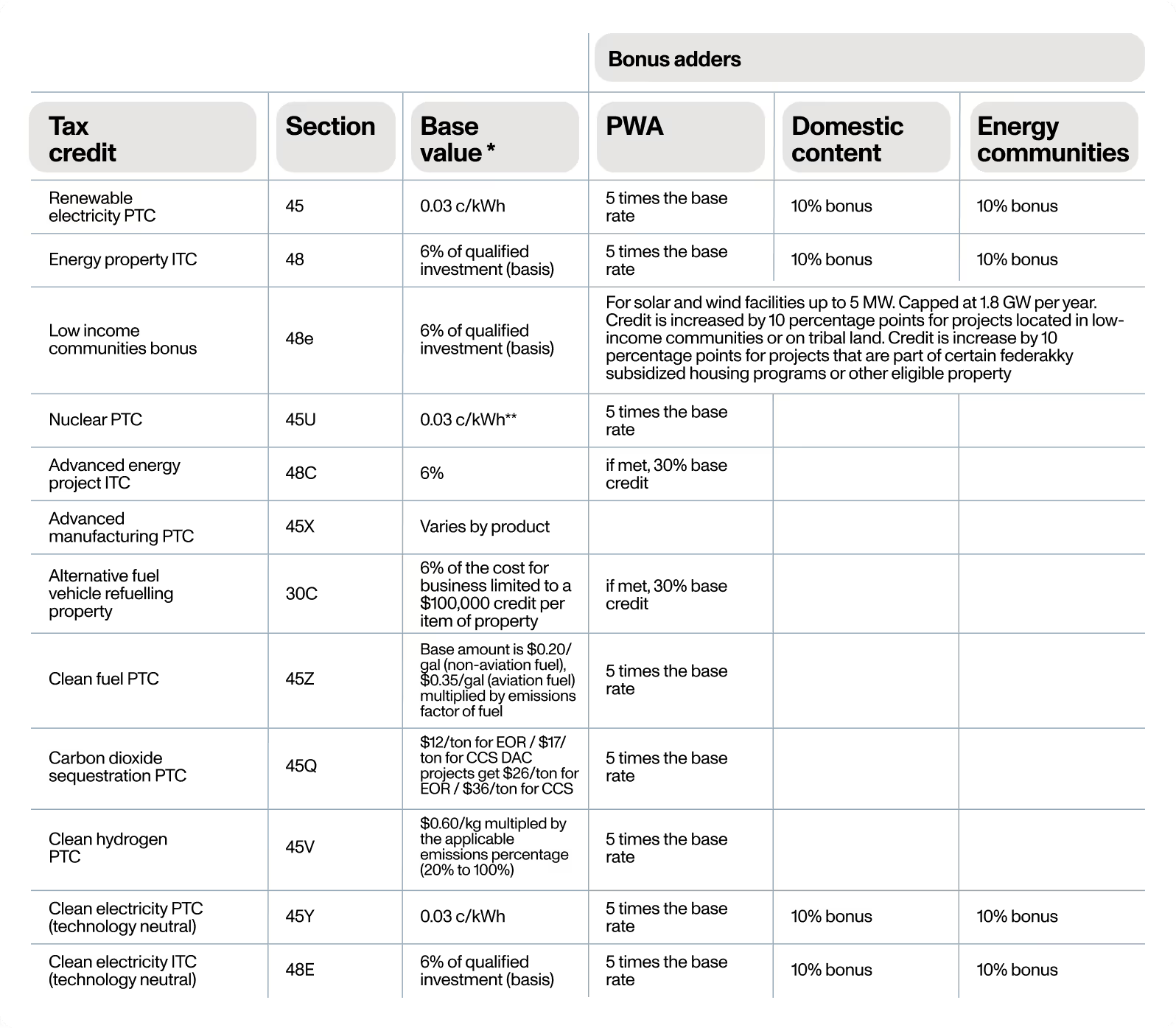
The prevailing wage and apprenticeship (PWA) bonus tax credit allows projects to claim a 30% investment tax credit — five times the 6% base rate — if they meet specific wage and apprenticeship requirements during construction and for five years post-service.
Projects that began construction before January 29, 2023, are grandfathered into the 30% ITC and are not required to meet PWA standards. Today, PWA-compliant projects are generally considered the baseline assumption for credit valuation.
Another valuable tax credit bonus is available to projects that meet domestic content adder requirements. To claim this adder, companies must demonstrate that projects meet domestic content standards for steel or iron constituent parts and manufactured goods.
For PWA-compliant projects, ,this boosts total ITC value from 30% to 40% of its eligible project cost.
Projects developed in communities or census tracts designated as energy communities can claim an additional 10-percentage-point increase in credit value. The IRA defines energy communities as:
Projects developed in low-income communities or communities designated as historic energy communities may access additional bonuses. The low-income communities bonus tax credit program is available to solar and wind projects under 5MWac that are installed in low-income communities or on tribal land.
Projects meeting these benchmarks can access a 10-percentage-point bonus above their baseline ITC or PTC rate. Alternatively, a 20-percentage-point credit increase is available to eligible solar and wind facilities that are part of a qualified low-income residential building or a qualified low-income economic benefit project.
Sellers typically cover transaction fees up to a negotiated cap. In addition to these fixed costs, the gross purchase price for TTCs would include costs associated with insurance and transaction fees. Insurance premiums, which are paid by the seller, often cost 2–5% of the insured limit of the credit (depending on deal size and risk), and deal fees range from 0.5–3.0%. Sellers are also typically responsible for the cost of their own legal counsel, as well as any appraisal or cost-segregation reports required to support credit eligibility.
For instance, if a project sponsor sells a credit for $0.90 gross (a 10% discount to the face value of the credit), obtains insurance for 2.75% of the face value of the credit, and pays a fee to an intermediary or broker for 1.25% the credit value, they will realize net proceeds of $0.86. If the buyer of the credit incurs $50,000 in additional advisory fees related to conducting due diligence on the transaction, and the seller has agreed to cover these fees up to that amount, then these costs would also be subtracted from the TTC sale to estimate the seller’s proceeds.
While transferable tax credits have broadened access to clean energy financing, tax equity can still be a strong option for developers seeking to monetize all available tax benefits. A key advantage is the ability to monetize accelerated depreciation, such as modified accelerated cost recovery system (MACRS) deductions, which can be especially valuable for capital-intensive projects. These benefits cannot be transferred and are only available to investors who are legal partners in the project, as in traditional tax equity structures.
Tax equity may also allow for a step-up in basis, increasing a project’s valuation from cost to fair market value and boosting the size of the ITC. This step-up generally requires a partnership structure and isn’t available in direct credit transfers, which are based on cost. For large projects or experienced sponsors, traditional or hybrid structures may offer more value. These “T-flip” models combine tax equity and transferability to balance simplicity with maximum benefit.
Transferable tax credit transaction timelines vary based on deal complexity, documentation readiness, and market conditions, but are typically faster and more flexible than traditional tax equity deals. On average, deals facilitated by Crux close in about three months. In contrast, tax equity deals often take six to twelve months due to bespoke structuring and deal complexity.
Ultimately, tax credit buyers prefer to transact with counterparties who are “ready to go,” which means organized, PWA-compliant sellers can often move faster from interest to close. To make this easier for sellers, Crux’s purpose-built diligence tools streamline documentation, automate workflows, and help accelerate clean energy transactions with greater efficiency.
For investment tax credits, the tax credit is generated when the facility is complete and placed in service. Importantly, projects that intend to claim the ITC but have regular, multi-year construction timelines may claim partial credits for qualified production expenditures (QPEs). These QPE credits are not eligible to be sold or transferred; only the ITC generated in the year the project is placed in service can be transferred.
Production tax credits are generated after a project enters service and begins producing energy. PTCs are generated for each unit of production (e.g., a megawatt-hour of electricity or a kilogram of hydrogen) for a long period of time — 10 years under federal tax policy.
Developers and manufacturers can sell forward a stream of future PTCs (or a “strip”), either as a production tax credit deal or as a tax equity transaction. Typically, a developer or manufacturer will sell a conservative estimate of their future PTCs in a forward transaction to minimize the risk that the facility will not generate enough energy in a year to meet the required supply of PTCs. Excess PTCs generated in each year can also be sold as “spot” PTCs, which must be sold in the tax year in which they are generated (or before the extended tax filing date for that year).
Buyers of tax credits often choose to execute transactions as close as possible to the end of their tax year (when they have the greatest certainty around their tax liabilities).
Bridge financing has become an increasingly important tool for clean energy developers and manufacturers seeking to access capital ahead of tax credit monetization. These short-term loans allow project sponsors to borrow against expected tax credit proceeds, helping to cover construction costs and improve cash flow while waiting for credits to be generated and sold.
Crux has observed growing lender appetite in this space as the market for transferable tax credits has matured. Today, multiple lenders are actively underwriting tax credit bridge loans for both ITCs and PTCs. These loans typically require a forward commitment from a buyer, providing the repayment certainty lenders need before the credit is delivered.
Bridge loan pricing and terms depend on several factors, including developer creditworthiness, documentation quality, and the presence of enhancements such as insurance. To support these transactions, Crux offers a debt capital markets solution, connecting developers with a network of active lenders while providing tools and data to streamline execution.
Whether you’re a developer or manufacturer, tax credit buyer, or tax advisor, Crux can help you make the most of the transferable tax credit market. With expert guidance, market-validated documentation, and a purpose-built platform, we’ll help you streamline your transactions and reduce risk.
Adder (bonus tax credit). A statutory bonus that increases the base value of a federal clean energy tax credit when the project meets a specified condition (such as paying prevailing wages, using domestic content, or being located in an energy community). Multiple adders may be stacked on a single project.
Basis (eligible basis). The cost basis of qualifying property on which an investment tax credit (ITC) is calculated. For credits transferred under §6418, basis is generally the project's actual cost — not a stepped-up fair market value.
Beginning of construction (BoC). The IRS-defined date on which a project is treated as having started construction for tax credit purposes. BoC can be established by either a physical-work test or a 5% safe-harbor test, and a project must demonstrate continuous progress toward completion afterward.
Bridge loan (tax credit bridge financing). A short-term loan secured by a developer's or manufacturer's expected proceeds from a future transferable tax credit sale. Bridge loans typically require a forward credit purchase commitment from a creditworthy buyer as the repayment source.
Brownfield site. A site contaminated or potentially contaminated by hazardous substances, pollutants, or contaminants, as defined under CERCLA. Projects located on brownfield sites can qualify for the energy community adder.
Carryback. The ability to apply unused tax credits to prior tax years. Under §6418, a credit buyer may carry transferred credits back up to three years. Carryback is applied to the earliest year first, then forward toward the current year.
Carryforward. The ability to apply unused tax credits to future tax years. Under §6418, a credit buyer may carry transferred credits forward up to 22 years from the year the credit was generated.
CERCLA. The Comprehensive Environmental Response, Compensation, and Liability Act — the US environmental statute that defines brownfield sites for purposes of the energy community adder.
Cost segregation report. An engineering-led analysis that allocates a project's total cost across eligible and ineligible categories for tax credit purposes. Cost segregation supports ITC valuation and is a standard diligence document in transferable credit transactions.
Direct pay (elective payment). A mechanism under IRC §6417 that allows certain tax-exempt entities, governments, and rural electric cooperatives to receive the full cash value of an eligible tax credit as a payment from the IRS. For most for-profit taxpayers, direct pay is available only for §45Q, §45V, and §45X, and only for a limited number of tax years.
Domestic content adder. A federal tax credit bonus of 10 percentage points (for the ITC) or 10% of credit value (for the PTC) for projects that meet US-content requirements for steel, iron, and manufactured products. Eligibility thresholds for manufactured products phase upward over time.
Elective payment. See Direct pay.
Energy community adder. A federal tax credit bonus of 10 percentage points (ITC) or 10% (PTC) for projects located in (a) a brownfield site, (b) a metropolitan or non-metropolitan statistical area with significant historical fossil-fuel employment or tax revenue and elevated unemployment, or (c) a census tract with a recently closed coal mine or retired coal-fired electric generating unit.
Engineering, procurement, and construction (EPC) agreement. The contract between a project developer and the firm responsible for building the project. The EPC agreement is a standard diligence document used to validate project cost and scope in transferable credit transactions.
Federal tax credit. A direct reduction of federal income tax liability, dollar-for-dollar. Federal clean energy and manufacturing tax credits include the §45 PTC, §48 ITC, §45Q, §45U, §45V, §45X, §45Y, §45Z, §48C, §48E, and others.
Foreign Entity of Concern (FEOC). Federal policy designation used to restrict eligibility of clean energy and manufacturing tax credits when a project, taxpayer, or supplier has specified ties to designated foreign jurisdictions. Distinct from but related to the OBBB's "prohibited foreign entity" rules.
Indemnity. A contractual promise by a credit seller to make a credit buyer whole if a transferred credit is later disallowed, recaptured, or reduced. Indemnities are typically backed by a parent guarantee, a tax insurance policy, or both.
Inflation Reduction Act (IRA). The 2022 federal statute that established or expanded most of the federal clean energy and manufacturing tax credits, and that enacted IRC §6418 (transferability) and §6417 (elective payment).
Investment tax credit (ITC). A one-time federal tax credit calculated as a percentage of an eligible project's cost basis, claimed in the year the project is placed in service. Codified at §48 (pre-2025 construction start) and §48E (post-2025 construction start).
IRC §6418. The Internal Revenue Code section, enacted in the 2022 IRA, that authorizes the one-time transfer of certain federal clean energy and manufacturing tax credits from an eligible taxpayer to an unrelated taxpayer for cash.
Low-income community bonus. A federal tax credit bonus available to small solar and wind facilities (under 5 MW AC) located in a qualifying low-income community, in connection with a qualified low-income residential building project, or as part of a qualified low-income economic benefit project. The bonus is 10 or 20 percentage points and is allocated annually by Treasury.
MACRS (Modified Accelerated Cost Recovery System). The federal depreciation regime that allows clean energy property to be depreciated on an accelerated schedule (typically 5-year). MACRS depreciation cannot be transferred under §6418 — it remains with the project owner — which is one reason tax equity remains preferred for projects where depreciation is a material share of total benefits.
Make-whole provision. An indemnity term obligating the credit seller to compensate the buyer for the full economic loss — typically including taxes, interest, and penalties — if a transferred credit is later disallowed or recaptured.
One Big Beautiful Bill (OBBB). The 2025 federal statute that modified many IRA-era clean energy and manufacturing tax credits, including phaseout schedules for wind and solar credits, the addition of prohibited foreign entity (PFE) rules, and the extension of certain credits (such as §45Z through 2029).
Parent guarantee. A credit support mechanism in which the parent company of a credit seller agrees to backstop the seller's indemnities. Parent guarantees are typically used by investment-grade sellers in lieu of tax insurance.
Passive activity. Under US tax law, an income- or loss-producing activity in which the taxpayer does not materially participate. Individual buyers of transferable tax credits are subject to passive activity rules: a credit's face value can generally only be applied against tax liability from passive, non-investment income.
Placed in service. The date a project is ready and available for its intended use. Placed-in-service date triggers ITC eligibility and starts the five-year recapture period.
Pre-filing registration. The mandatory IRS process through which a credit seller obtains a registration number for each eligible credit property before a transfer election can be filed. The IRS typically recommends allowing 120 days for processing.
Prevailing wage and apprenticeship (PWA). A set of federal labor standards that, when met during a project's construction and continued for the credit's recapture or production period, multiply the base ITC or PTC rate by 5×. PWA compliance is now the baseline assumption for credit valuation in most clean energy transactions.
Production tax credit (PTC). A federal tax credit earned per unit of qualifying output (e.g., per kWh of electricity, per kg of hydrogen, per gallon of clean fuel, per component manufactured), claimed each year for a defined period after the project enters service. Codified at §45 (pre-2025 construction), §45Y (post-2025 construction), §45Q, §45U, §45V, §45X, and §45Z, among others.
Prohibited Foreign Entity (PFE). A category of entity defined in the OBBB whose involvement in a tax credit–eligible project or supply chain disqualifies the project from claiming certain credits. Used in this guide for OBBB-specific compliance; distinct from the broader FEOC concept.
Provisional emissions rate (PER). An emissions value issued by the IRS for fuel pathways not listed in published emissions tables. PERs are most commonly encountered in §45Z (clean fuels) and §45V (clean hydrogen) transactions.
Purchase and sale agreement (PSA). The principal commercial contract between a credit buyer and seller in a transferable tax credit transaction. The PSA documents purchase price, payment terms, representations and warranties, indemnities, and conditions precedent to closing.
Qualified production expenditures (QPE). Project costs incurred during multi-year construction of a planned ITC project. QPE credits are not eligible to be sold or transferred; only the full ITC generated in the placed-in-service year can be transferred.
Recapture. The IRS's right to reclaim a previously claimed investment tax credit if the underlying project ceases to be eligible during the five-year recapture period beginning on the placed-in-service date. Recapture applies only to ITC-generating credits (§48, §48E); PTCs are not subject to recapture once earned.
Recapture period. The five-year period following an ITC project's placed-in-service date during which the project must remain in qualifying use. The recapture risk to the buyer steps down 20 percentage points per year.
Registration number. The unique identifier issued by the IRS at the end of the pre-filing registration process. The registration number must appear on the transfer election statement and on both parties' tax returns for each transferred credit.
Safe harbor. A regulatory provision under which a taxpayer is treated as having met a specific requirement if certain documentation or thresholds are satisfied. Examples in transferable tax credits include the 5% safe harbor for establishing beginning of construction and the safe harbors introduced in the February 2026 proposed §45Z regulations.
Step-up in basis. An increase in the tax basis of project assets from cost to fair market value, achievable under a tax equity partnership structure. A step-up can increase the size of the ITC relative to a cost-basis calculation, but is not available in direct §6418 credit transfers.
Strip (tax credit strip). A multi-year forward commitment from a buyer to purchase a defined volume of future PTCs from a project. Strips are most common in §45 / §45Y wind and solar PTC transactions but are also used for §45X (typically in 2–3 year strips) and §45U (typically 1-year tranches).
Sustainable aviation fuel (SAF). A renewable jet fuel that is chemically similar to conventional jet fuel but has lower lifecycle GHG emissions. SAF is one of six fuel categories eligible for the §45Z credit.
T-flip (transferability + tax equity hybrid). A hybrid project finance structure that pairs a traditional tax equity partnership — which captures depreciation and, where available, a step-up in basis — with a transfer of the credit itself to a third-party buyer under §6418. T-flips are increasingly used by large sponsors that want to combine tax equity economics with the broader buyer pool transferability unlocks.
Tax equity. A project finance structure in which an institutional investor enters a partnership with the project sponsor and receives a special allocation of tax credits, depreciation, and cash distributions in exchange for upfront capital. Tax equity is the foundational structure that has financed the majority of US utility-scale renewables; transferability is a complementary path that broadens access.
Tax insurance (tax credit insurance). An insurance policy that protects the credit buyer (or, in some cases, the seller) against loss arising from credit disallowance, recapture, basis disputes, or qualification risk. Coverage levels typically range from 90% to 140% of credit value, with premiums of 2%–5% of insured limit; the seller typically pays the premium.
Term sheet. A non-binding written summary of the principal commercial terms of a proposed tax credit transaction, used to align buyer and seller before purchase and sale agreement (PSA) drafting. Legal-fee reimbursement provisions in a term sheet are typically binding even when the rest is not.
Transfer election statement. The IRS-required statement attached to both the seller's and buyer's tax returns documenting a credit transfer under §6418. The transfer election must occur before either party files the relevant return.
Transferability. The legal mechanism, established by IRC §6418, that permits a one-time sale of certain federal clean energy and manufacturing tax credits from an eligible taxpayer to an unrelated taxpayer for cash. Transferability is distinct from direct pay (which provides a cash refund from the IRS) and from tax equity (which uses a partnership structure).
Transferable tax credit (TTC). A federal clean energy or manufacturing tax credit that an eligible taxpayer can sell, one time, to an unrelated taxpayer for cash under IRC §6418. The 11 currently transferable credits are §30C, §45, §45Q, §45U, §45V, §45X, §45Y, §45Z, §48, §48C, and §48E.